FOR IMMEDIATE RELEASE
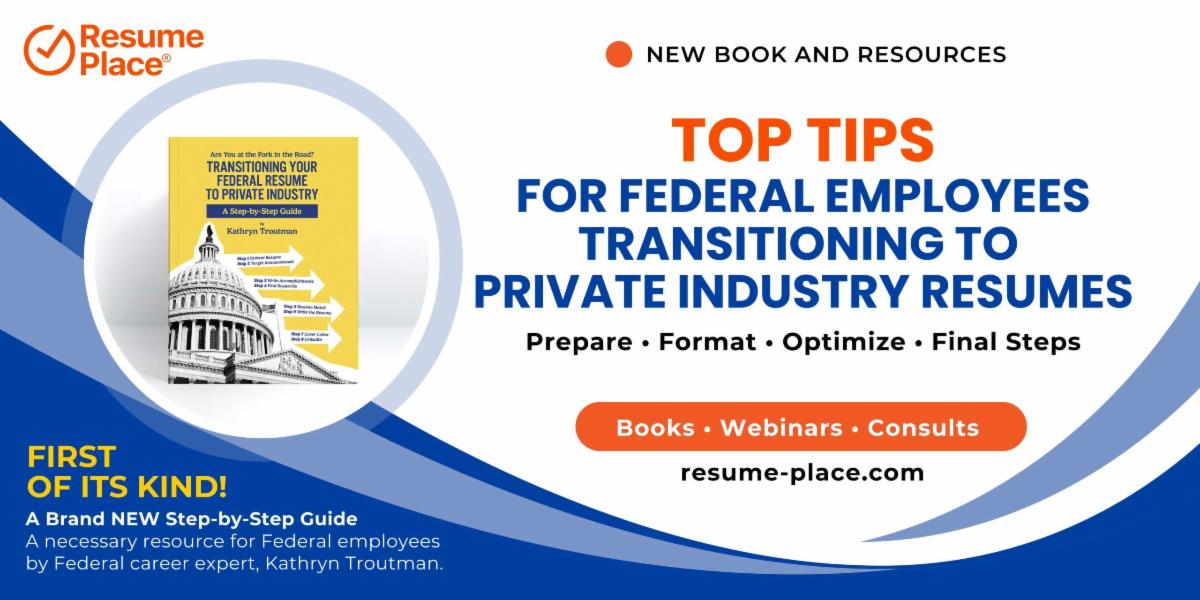
Top Tips for Federal Employees Transitioning to Private Industry Resumes
“Read Top Tips for Resume Writing Article here“
By Kathryn Troutman, Baltimore, MD
Transitioning from federal service to the private sector can feel like learning an entirely new language. Your years of valuable government experience need translation to resonate with corporate hiring managers. We understand this challenge and are committed to helping you bridge this gap with practical, proven strategies that highlight your unique value in the private job market.
Preparation
- Start with what you have: Update your federal resume with recent positions, dates, training, and education to use as reference material.
- Research job titles: Identify private industry equivalents to your federal position. Test potential titles on job boards like LinkedIn and Indeed to see what matches your skills and experience.
Extract Accomplishments
Accomplishments are the heart of an effective private industry resume. Unlike federal resumes that focus on duties and responsibilities, corporate employers want to see the tangible impact you’ve made.
- Review your work history and identify 3-5 significant achievements from the past five years that demonstrate measurable results and impact.
- Quantify achievements: Transform responsibilities into accomplishments by including metrics, results, and specific impacts (e.g., “reduced processing time by 30%”).
- Edit each accomplishment to approximately 50 words, to keep your resume to 2 or 3 pages.
Example 1:
Before (Responsibility-focused): Responsible for managing a team of IT specialists implementing new cybersecurity protocols across multiple agency departments according to federal compliance requirements.
After (Accomplishment-focused): Led cross-functional team of 12 IT specialists in deploying enhanced cybersecurity protocols across 5 departments, reducing security incidents by 47% and achieving compliance certification 3 months ahead of schedule while $175K under budget.
WOW, Way Better!
Example 2:
Before (Responsibility-focused): Served as procurement officer overseeing acquisition processes for equipment and services according to federal guidelines and regulations.
After (Accomplishment-focused): Streamlined procurement processes that reduced acquisition cycle time from 90 to 45 days, resulting in $1.2M annual savings. Negotiated enterprise-wide software agreement that provided 30% cost reduction while expanding access to critical tools for 2,500 employees.
WOW, Way Better!
Format and Structure
- Keep it concise: Limit your resume to two pages for corporate positions (three pages acceptable for state/municipal applications).
- Use clean formatting: Choose readable fonts like Arial or Times New Roman at 12-point size with 0.75-inch margins. Avoid templates that waste space or use difficult-to-read fonts.
- Focus on recent experience: Emphasize your last 10 years of work history, with only brief mentions of older experience. Remove anything beyond 20 years entirely.
- Protect your privacy: Include only your city, state, email, and phone number—omit your street address.
Content Optimization
- Speak the language: Analyze target job descriptions for industry keywords and terminology, then incorporate these into your resume to align with both human readers and AI screening systems. Key AI-friendly keywords by field:
- IT/Cybersecurity: cloud infrastructure, DevOps, agile methodology, threat detection, NIST framework
- Project Management: PMP, agile, scrum, stakeholder management, risk mitigation, ROI
- Finance/Accounting: financial analysis, cost reduction, budget optimization, compliance, audit
- Leadership: strategic planning, team development, change management, performance metrics
- Translate federal terms: Convert government-specific language, acronyms, and position titles into private industry equivalents that hiring managers will understand.
- Highlight transferable skills: Emphasize skills valued across sectors like project management, budget oversight, leadership, and technical expertise.
Final Steps
- Include a cover letter: Always accompany your resume with a targeted cover letter that explains your federal-to-private transition and highlights relevant experience.
- Get feedback: Before submitting, have someone from private industry review your resume for government jargon and overall effectiveness.
- Customize for each application: Tailor your resume for specific positions rather than using a one-size-fits-all approach.
For more information and help…
(1) Buy our new book Transitioning Your Federal Resume into Private Industry – Kathryn Troutman, which contains seven samples of private industry resumes.
(2) Consider purchasing a one-hour consult to get started with (or secure a review and critique of) your new private sector resume:
Questions about how we can help you with this career transition?
RESUME PLACE, INC., www.resume-place.com
